Weight, health and inner landscape part 1, or: when we can feel ourselves clearly, we rely less on external measures to tell us how we’re doing.
Feb 13, 2026
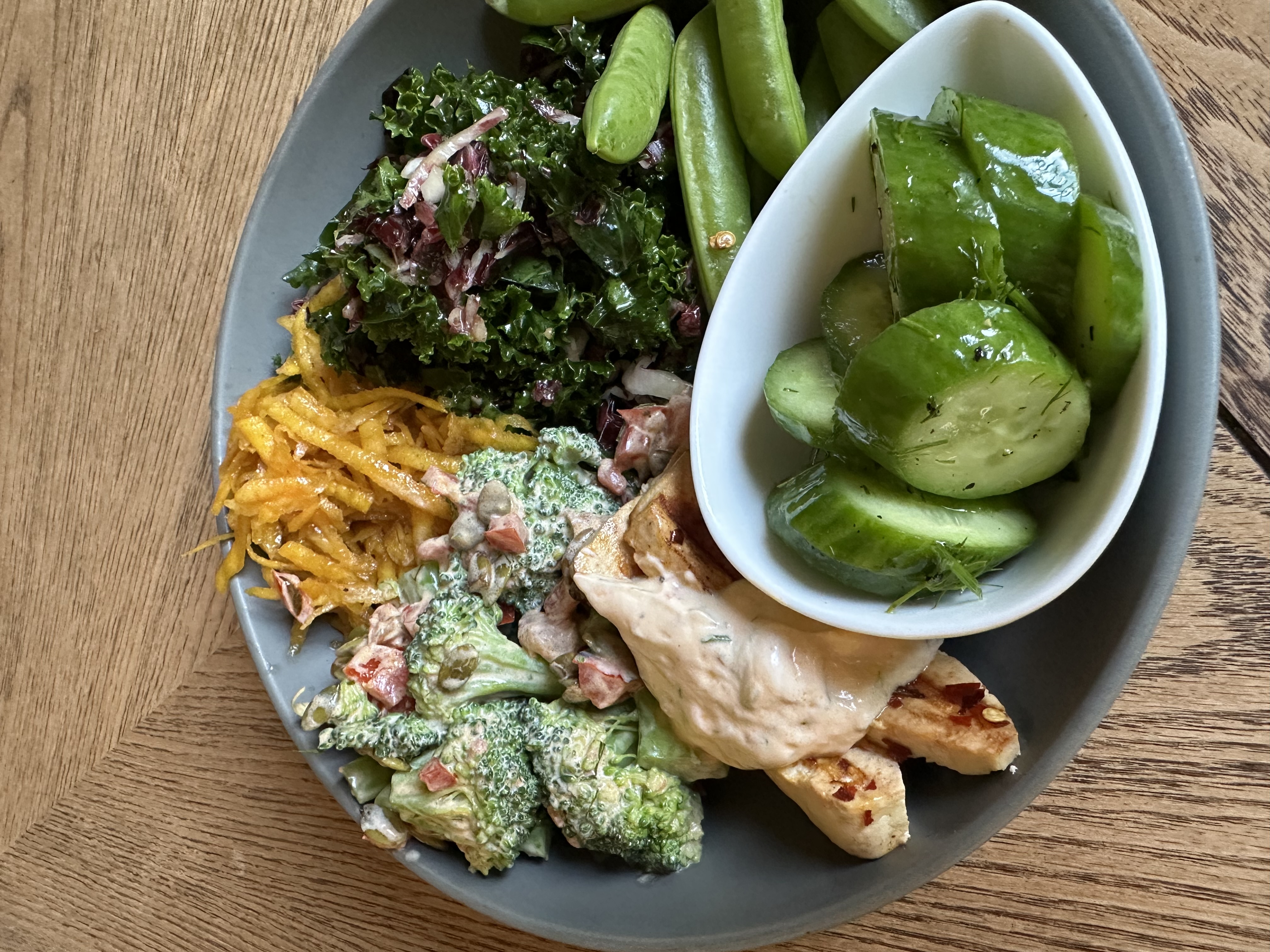
When I don’t pause to notice my state and name the qualities present — tired, rushed, heavy, scattered, bright, steady — I can feel it in the food I make. The meals come out less satisfying, harder to digest, sometimes too dense, and the flavours lack their usual lift. I jokingly call this kind of cooking “Grey’ge,” as if the colours and aliveness have been muted.
The other night I suggested going out for dinner, and Colin said the food is rarely as good as what I make. He may be biased because he loves me, or because he’s used to my flavouring, but there is some truth there. Unless we’re somewhere like The Acorn, Meet on Main, or East is East in Vancouver, we often notice that brightness is missing. What may also be missing is the balance my body actually needed that day. When that balance isn’t there, I’m left feeling sleepy, bloated, or agitated.
I’ve spoken often about food and how I approach it, but I want to be clear about something important: I don’t eat to look a certain way. Each of us has a unique balance to find, and that balance has very little to do with the shape of our body. This is part of why I feel compelled to write about bias. Many of the ideas we carry about food, weight, and health are so woven into the fabric of our culture that they start to look like logic. They quietly tint the lens through which we see ourselves and others, and we don’t even realize they’re there.
Weight is often treated as a primary marker of health. It is visible, measurable, and easy to compare. Numbers on a scale, the fit of clothing, and changing body shapes can quietly become the reference points people use to judge how well they are doing.
But weight, on its own, is not a direct indicator of health. It does not tell the full story of how a body is functioning, how a nervous system is coping, or how a person is actually living and feeling inside.
Ayurveda offers a broader lens. Instead of focusing on size, it looks at qualities and patterns to understand balance. Health is observed through function and experience, not just appearance.
Some of the more meaningful indicators include:
• Quality of sleep
• Ease of digestion
• Regular elimination
• Steadiness of the nervous system
• Energy levels throughout the day
• Ability to adapt to stress
Digestion, in this view, is not just about food. We digest our entire world through the senses:
• Images
• Sounds
• Smells
• Tastes
• Physical sensations on the skin and in the muscles
• The constant stream of experiences we take in each day
Some days this flow moves through us easily. Other days it is overwhelming. Balance is reflected in how well we can receive, process, and respond to life.
Bodies are complex systems shaped by hormones, genetics, stress, sleep, and metabolism. Thin people develop heart disease. Larger people can eat carefully and exercise consistently and remain the same weight. Size alone cannot explain health.
When we focus only on the external shape of the body, we can miss more subtle and meaningful signals. We can begin instead to look at how we feel living inside ourselves:
• Do I feel steady in my nervous system?
• Am I sleeping well and waking rested?
• Does my digestion feel smooth and predictable?
• Do I feel present in my senses during daily life?
And — How would I be able to discern these things!
Even simple daily tasks can reveal a lot about integration and health.
When making a meal:
• Do I notice the colours, smells, and textures I’m cooking with?
• Does my body feel coordinated and integrated while I prepare food?
• Am I aware of where I am in space?
• Do my movements feel cohesive and connected?
This is the work of proprioception and interoception — sensing the body from the inside out. When these inner senses are clear, they become a quiet guide. We begin to rely less on external measures to tell us how we are doing, and more on our direct experience.
Yoga invites self-study. It asks us to observe without immediately trying to fix or improve. Over time, that observation becomes a kind of intelligence.
There is another layer to this conversation that many people recognize from personal experience. In medical settings, stepping on a scale is often presented as non-negotiable. Doctors are trained to work with measurable data. Numbers provide a sense of comparison and tracking over time. It makes sense that the system leans on them.
But the number on a scale is not always the most meaningful marker for every person.
Years ago, I found myself in a difficult conversation with my doctor because I did not want to know my weight. I had already learned that hearing the number did not help me understand my health. Instead, it often left me feeling like I had failed in some way, even when I felt strong and capable in my body.
He was very insistent. Eventually, I agreed to step on the scale backwards. I asked him not to say the number out loud and to put a note in my chart that I did not want to know it.
On the surface, this may sound like a small request. But it points to something larger — a system that can sometimes rely heavily on numbers, charts, and criteria to define a person’s health. Those standards change over time. Tables are updated. Guidelines shift. Yet the person sitting in the room may not feel fully seen.
Writers like Aubrey Gordon have shared many lived experiences that reveal how common and subtle body-based assumptions can be. These moments are not always loud or dramatic. Often, they are quiet, passing, and cumulative. Over time, they shape how a person sees themselves.
She often speaks about how bias does not live only in obvious cruelty. It appears in everyday assumptions, especially in medical care, education, work, and public spaces. She describes how the constant stream of small comments and unsolicited advice becomes something people carry internally for years.
One childhood memory she shared stays with many readers.
• A small child once pointed at her and said, “fat lady.”
• The child’s parent reacted quickly, shushing and correcting, as if the word itself was something shameful.
• She later reflected that the reaction suggested that simply naming her body was something to hide or be embarrassed about.
This moment reveals something subtle. The child was simply noticing. The adult was reacting to the cultural meaning attached to the body. And the person in the body was left holding both reactions.
She also speaks about how often people assume they are helping:
• Strangers offering diet advice in grocery stores
• People commenting on food choices
• Conversations that begin with concern but carry an unspoken message: you should not look like this
These interactions are often framed as care, but they can leave someone feeling judged, watched, and misunderstood.
One of the most striking medical stories she shared fits closely with this theme.
• She visited a new doctor seeking care.
• Before asking about sleep, digestion, history, or symptoms, the doctor told her he would not treat her until she lost 100 pounds.
• At the time of that appointment, she had already lost 100 pounds.
The assumption came first. Curiosity never arrived. The person in front of him went unseen.
Prejudice can move in many directions. At one time when I was quite slim, I was trying on pants in a store. They were baggy at the waist, so I asked if there was a smaller size. The woman helping me became visibly irritated and said sharply that this was the smallest size they carried, then turned away, annoyed.
It was confusing. I hadn’t intended to cause frustration or offense. But the interaction stayed with me. Being judged in public, regardless of the direction of that judgment, can feel unexpectedly painful. It reminds us how quickly bodies can become the focus of other people’s reactions.
Photographer Haley Morris-Cafiero explored similar experiences through her project documenting everyday reactions from strangers in public spaces. Her photographs captured quiet stares, subtle gestures, and the constant awareness of being watched. Her intention was not to shame anyone, but to make visible the everyday nature of these interactions.
Historically, early fat liberation activists like Judy Freespirit spoke about being restricted and shamed around food from a very young age. Those early experiences shaped their relationship to their bodies and later became part of their advocacy.
Across these stories, a pattern emerges. Over time, people begin to:
• Anticipate judgment
• Move differently in public
• Make choices based on fear rather than need
• Disconnect from inner signals
And yet there are also stories of quiet shifts.
For Aubrey Gordon, overcoming shame did not come from changing her body. It came from changing her relationship to herself and to the cultural messages around her. Writing, speaking, and being visible became ways of reclaiming dignity and presence in her own body.
These stories remind me
that when we talk about weight and health, we are not just talking about food, exercise, or numbers. We are talking about perception. About identity. About how we learn to see ourselves.
Sometimes, the deepest practice is not changing the body at all. The work, gently and slowly, is to return to that inner knowing. Health as a relationship to sensation, digestion, sleep, movement, environment, and self-perception.
As the nervous system becomes more balanced, different markers begin to matter more. Sleep feels deeper. Digestion steadier. Movement more integrated. The senses feel alive but not overwhelmed.
From this place, food and lifestyle choices tend to shift naturally. They come from care instead of correction. From curiosity instead of pressure. From relationship rather than control.
Weight may change. Or it may stay the same.
But health begins to be measured in more meaningful ways — through steadiness, awareness, responsiveness, and a growing sense of ease inside one’s own body.

Stay connected with news and updates!
Join our mailing list to receive the latest news and updates from our team.
Don't worry, your information will not be shared.
We hate SPAM. We will never sell your information, for any reason.
