Weight and the inner landscape part 2 or: Now we practice
Feb 20, 2026
Bringing Practice Into the Conversation
In sharing ideas about practice, I sometimes wonder if it is more helpful to show the details of how I choose, rather than offering general guidelines. Not as suggestions to follow, but as an example of how a mind can learn to notice what is needed and work with the tools it already has.
There was a year that felt particularly hard. My daughter was away on a Quebec exchange, and many parts of that experience became complicated, confusing, and emotionally demanding. During that time, I created a simple, steady asana practice that I repeated almost every day. It included diverse movements woven into 12 sun salutations with lunges. After that portion, I moved into Triangle pose, Warrior 1 and 2, Crow pose, and then Headstand and Shoulderstand. I did this same “dance number” for a full year.
The repetition helped gather the scattered, fluctuating energy of that time. Not needing to think about what to do next allowed my mind to rest. I am usually drawn to more varied and creative practices, but this was the medicine that supported me then. When that year passed, I naturally shifted out of the daily repetition. Now I return to that sequence about once a week, almost like visiting an old friend.
My current rhythm is organized loosely through the week. Monday tends to be upper body strength work. Tuesday, I return to that familiar sequence from that earlier year. Wednesday is forward bends. Thursday explores deeper backbends. Friday becomes a tensegrity-repair style practice. Saturday is more limbering and often includes teaching. Sunday is my “longer game,” where I move through all planes of motion and include the whole body.
This rhythm helps me avoid only practicing what comes easily. I make sure to include flexion, extension, lateral movement in the frontal plane, and transverse movements like twisting. It keeps me honest and attentive.
Some days I need to begin on the ground with sitting and pranayama before anything else. Other days I need to start with movement, either on the floor or standing. I begin sensing what I might need long before I enter the studio. Even while showering or getting ready, I start noticing the quality of my energy, my breath, and my thoughts.
Recently, I had a morning where I knew what I needed, but I began puttering around the house before practice, trying to prepare for the woman who comes to clean. I noticed my diaphragm getting tight as I worried the house wouldn’t feel tidy enough for her arrival. My breath became shallow, and my mind felt narrow and strained. By the time I made it to the mat, I felt uncomfortable and unsettled.
That day I needed to go straight to sitting. It took about fifteen minutes for my mind to settle and my breath to deepen. Slowly, a steadiness returned. The “good mood of the mind,” as Orit Sen Gupta describes it, began to emerge. From there, perspective came back. It felt as though the lens had been gently cleaned, and I could sense myself from the inside again.
This is the part of practice that feels most real to me — not the poses themselves, but the ongoing learning of how to notice, respond, and adjust. Over time, the mind learns how to process what is needed, and the body becomes a familiar place to listen.
A Gentle Note on Where This Comes From
Everything I share here comes from what I have learned over time from Ayurveda practitioners, and from my own lived practice of paying attention. None of it is meant to be prescriptive. It is not a set of rules or a formula to follow. It is simply the accumulation of what my own body seems to reveal when I listen closely.
People often say to me, “You are so healthy.” I receive that kindly, but the truth is, I don’t know that I am any healthier than the next person. I don’t measure it that way.
Instead, I sense it moment by moment.
I notice how I feel inside. I notice how steady or unsettled my nervous system is. I notice how clearly I can perceive what is happening in and around me. My idea of health has become less about outcomes and more about the clarity of my inner lens. My take away from what Baba Hari Das from the Salt Spring Centre of Yoga said is, we are all shiny coins, but they become tarnished - Our yoga practice is to polish the tarnish off to see the see our own shiny self, and to better have perspective of the world around us.
What works for me today may not work tomorrow. What supports me may not support someone else. Bodies shift. Needs change. Energy changes. Life changes.
So this becomes an ongoing yoga practice of noticing. I’m not going to lie, it is conscious work, however it pays off.
Noticing without judgment.
Seeing without trying to immediately fix.
Allowing the body and mind to show themselves as they are.
From there, choices begin to emerge more naturally. Not from pressure or comparison, but from relationship and understanding.
Understanding that weight is not the sole indicator of health can be freeing. But then comes the practical question: how do we live this way? How do we move from theory into daily life, where choices about food and movement are happening all the time?
Ayurveda offers a very human starting point.

Before making a meal, pause for one minute.
Just one minute to feel inside.
Notice how the day has gone so far. Notice what is still ahead. Sense the state of your body, your mind, your energy. From there, begin to consider the qualities present in you and the qualities you may need more of to find balance.
You might notice things like:
- Feeling cold or overheated
- Feeling scattered or grounded
- Feeling emotionally heavy or physically depleted
- Feeling dry, restless, or dull
- Feeling sharp, driven, or tense
Work with qualities and their opposites. The idea is not to follow a strict diet, but to respond to what is happening in the moment.
For example:
- If you feel cold, you might add warmth through hot foods, soups, stews, or warming spices.
- If you feel overheated, you might lean toward cooling foods like yogurt, cucumber, or simply cooler temperatures in what you eat.
- If your mind feels scattered, heavier and more grounding foods can help — soups, stews, whole grains (if you digest them well), denser proteins, or healthy fats.
- If you feel physically or emotionally heavy, you might eat a little less at that meal or choose something lighter.
That last one can be more complex. Emotional heaviness sometimes needs care, support, or rest more than it needs food changes. It asks for gentleness and curiosity rather than quick correction.
This is why working with a knowledgeable practitioner can be so helpful. My own trusted guide in this area has been Mona Warner, (www.monawarner.com) whose steady understanding of balance and observation has shaped how I approach these daily choices.
Another important part of the weight and health conversation is movement.
I see people who are afraid of their body’s shape in some way. Too thin. Too heavy. Too stiff. Too soft. The responses to these fears are often not kind. They are driven by the anticipation of judgment, by years of absorbed messages, and by the quiet stories running in the background of the mind.
So what is the recipe for movement that includes intelligent seeing and kindness?
We can begin the same way we do with food.
Pause for one minute.
Before stepping into a practice, check in with what your trifecta needs: Body, Mind, Spirit — the Triputy. Notice the same qualities you noticed before the meal, or discover new ones that have surfaced.
Ask yourself, what might bring balance today? This is the time to put it into your science lab to see what works.
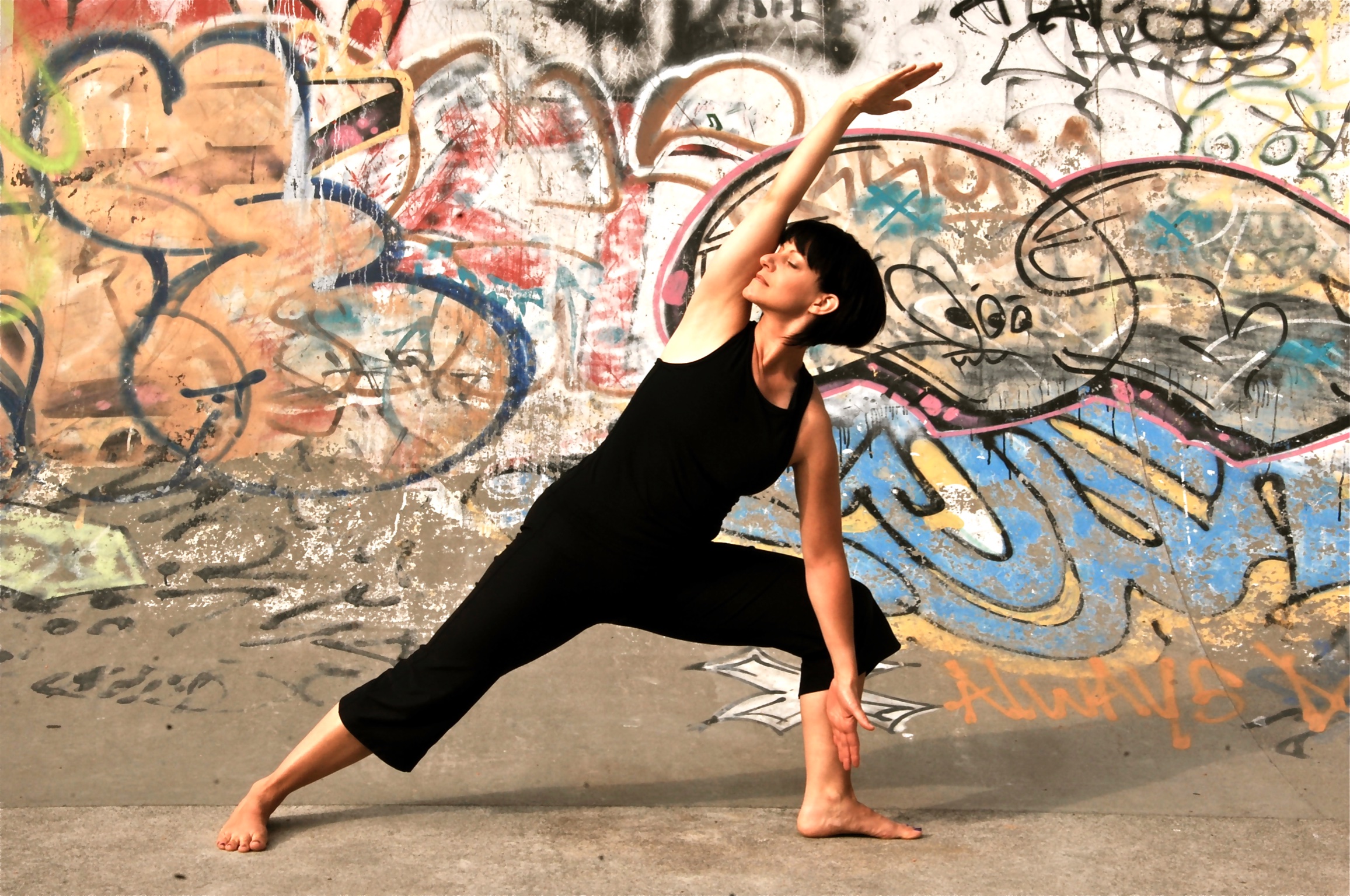
If the mind or body feels overheated or agitated, a strong or stimulating practice may not be the medicine. Headstands, for example, can intensify heat and intensity unless they are already part of a steady, familiar routine that you know how to practice with a sense of coolness and ease. Using rhythmic repeated patterns of movement can balance the agitated mind, or a yin style practice of longer holdings in easier poses.
If you feel sluggish or dull, gentle sun salutations might help bring circulation and clarity. But even then, there is no need to be forceful. Move slowly. Give yourself permission not to jump back. Be open to doing only a few rounds. Give yourself permission to stop or alternatively, to continue longer.
There are endless ways to work with opposites in a yoga practice, but it rarely comes down to getting the formula exactly right. It becomes a process of trial and error, observation, and acceptance.
This is where ahimsa, kindness, becomes essential.
We are not trying to “fix” a bad thing in the body or mind. We are learning to notice what is present and to choose the low-hanging fruit that is available that day.
Some days the fruit is very small.
Today, I arrived at my studio intending to do a longer, more involved personal practice. But when I paused and felt inside, I realized that pushing into that kind of session would leave me feeling sad. So I started lower to the ground. Quieter. Simpler. I stayed with what felt manageable.
And from that place, the practice slowly built into something sweet.
This is often how it works.
When we begin where we are — rather than where we think we should be — the body and mind respond. Susi Hately of Functional Synergy says to meet our students where they are at now, and I note that, we ourselves are our own students.
The principle underneath this is ancient and sneaks through a lot of traditions: the observer and the observed aren’t separate for long. The teacher stance and the student stance live in the same body, trading places all day. That’s svadhyaya in motion — self-study not as analysis, but as companionship.
Integration grows. Ease returns. And from that ease, change happens in a way that feels supportive rather than forced.
Stay connected with news and updates!
Join our mailing list to receive the latest news and updates from our team.
Don't worry, your information will not be shared.
We hate SPAM. We will never sell your information, for any reason.
